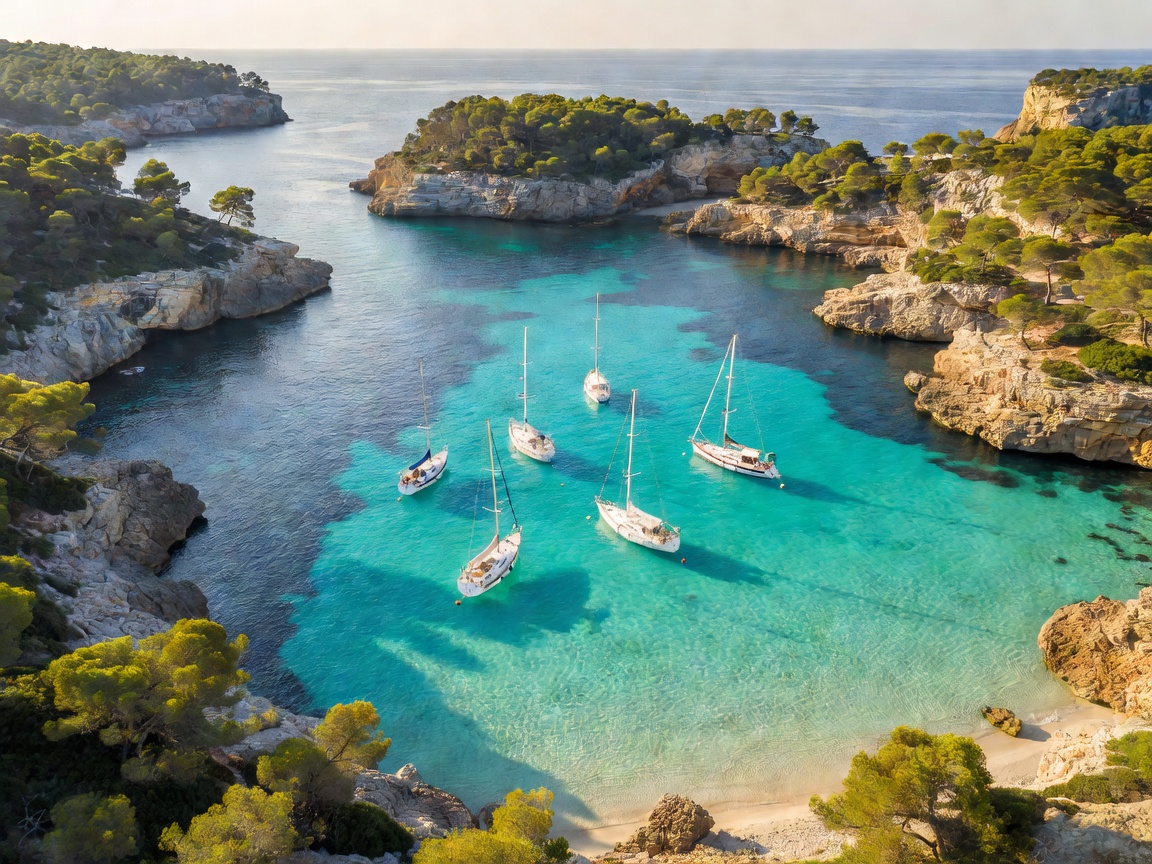
1. Why Mallorca Defies Expectations
The largest island in the Balearic archipelago, Mallorca spans over 3,600 square kilometers of extraordinarily diverse terrain. While package tourism built its modern reputation around the southern bays, the real allure lies in the north and west: ancient olive terraces, centuries-old dry stone walls (GR221 Dry Stone Route), and secluded rocky swimming calas accessed only by foot or tender boat.
2. Exploring the Serra de Tramuntana (UNESCO World Heritage)
The spine of northwest Mallorca is dominated by the limestone peaks of the Serra de Tramuntana, stretching 90 kilometers from Andratx to Cap de Formentor:
- Valldemossa: Perched at 400m elevation, home to the Royal Carthusian Monastery where composer Frédéric Chopin spent the winter of 1838.
- Deià: A historic artists' sanctuary surrounded by ancient olive groves, with a path leading down to the pebble cove of Cala Deià.
- Sóller & Port de Sóller: Nestled in the "Valley of Oranges", linked to Palma by the historic 1912 wooden vintage train and connected down to its circular natural harbor by an antique tram.
- Sa Calobra & Torrent de Pareis: A daring serpentine mountain descent ending in a natural gorge that cuts through towering cliffs to the sea.
3. Top Secret Calas & Coastal Swimming
Mallorca's southeastern coast is serrated by hundreds of "calas"—narrow limestone fjord-like sea inlets filled with vivid turquoise water:
- Caló des Moro: A breathtaking, narrow inlet with translucent turquoise water and natural sandy pockets (visit early morning to avoid crowds).
- Cala Varques: An undeveloped cove near Manacor accessible via a 20-minute pine forest trail, famous for its natural sea arches and caves.
- Cala Tuent: A peaceful, pebble-lined cove in the shadow of Puig Major with far fewer visitors than neighboring Sa Calobra.
4. Ferry Connectivity to Mainland Spain & Menorca
Mallorca features two main ferry ports: Palma in the southwest and Alcúdia in the northeast:
| Route | Operator | Transit Time | Vehicle Friendly |
|---|---|---|---|
| Barcelona ➔ Palma | Balearia / Trasmed | 7h 30m (Overnight) / 5h 30m (Fast) | Yes |
| Dénia / Valencia ➔ Palma | Balearia / GNV | 5h 00m | Yes |
| Alcúdia ➔ Ciutadella (Menorca) | Balearia / Corsica Ferries | 1h 15m (Fast Ferry) | Yes |
| Palma ➔ Ibiza (Botafoc) | Balearia / Trasmed | 2h 15m | Yes |
5. Best Time to Visit & Driving Advice
The optimal months for Mallorca are May to June and September to October, when the Mediterranean sea is warm, mountain roads are uncrowded, and daytime temperatures hover comfortably between 23°C and 27°C. Renting a compact car is essential for navigating narrow village alleyways and mountain hairpins.